Roulette’s Layout Is a Map of Bet Types
A roulette layout maps bet types by where their marks sit. Learn how inside and outside areas are named, grouped and read without choosing a wager.
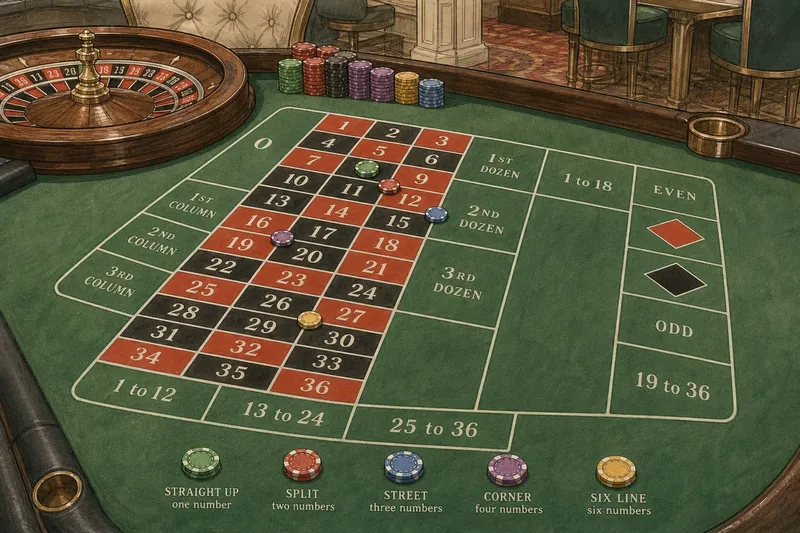
A roulette layout maps bet types by placing their marks in distinct areas around the numbered grid. Read it as a vocabulary of possible wagers: the position and shape of a marked area tell you which numbers or group a bet refers to, not whether you should make it.
The printed surface can look busy at first, especially beside a wheel whose numbers appear in a different order. But the table is organised for reading. The central grid holds individual numbers and small combinations; the broader labels around it refer to larger groups. That distinction is the basic map behind the terms “inside” and “outside”.
What does the roulette layout show?
The layout is a labelled diagram of the betting areas available on that table. On a common European-style layout, the numbered grid runs from 1 to 36, with a separate 0 space. Around the grid are marked areas for wagers that cover several numbers at once.
Each bet is represented by a patch of table cloth, a line, or a printed label. A chip placed in a particular area is read according to the rules for that area. The printed position therefore acts like a small map legend: it connects a physical spot to a defined set of numbers.
Layouts vary. A single-zero table and a double-zero table do not show the same number spaces, and table designs can differ in typography, colour and the placement of labels. The grouping principle remains easy to recognise, but a reader should use the marks on the specific layout in front of them rather than assume every table is identical.
What makes a bet “inside” or “outside”?
“Inside” and “outside” describe where a bet is placed on the layout and, broadly, how many numbers its marked area covers. Inside bets sit on or within the numbered grid and identify one number or a compact combination. Outside bets occupy the surrounding bands and name larger groups.
The terms are about table geography, not about the wheel’s inner or outer rim. A straight-up bet on one number is an inside bet because its mark belongs to the grid. A bet on red is an outside bet because its marked area sits beyond the numbered cells.
This is a useful distinction when reading a diagram or watching a dealer announce a wager. The word “outside” does not mean that a bet is off the table, and “inside” does not indicate a special area of the wheel. They are conventional names for the layout’s two broad regions.
Which marks count as inside bets?
Inside bet areas identify a number or a small group of adjacent numbers. The exact boundary of the chip placement determines which combination the layout represents.
- Straight-up: a mark within one numbered cell, referring to that single number.
- Split: a mark on the dividing line between two neighbouring cells, referring to those two numbers.
- Street: a mark at the end of a horizontal row of three numbers, referring to that row.
- Corner: a mark at the meeting point of four cells, referring to the four numbers around that corner.
- Six line: a mark at the boundary shared by two adjacent rows, referring to the six numbers in them.
These names make more sense when the grid is treated like graph paper. A single square identifies one cell, while a boundary or junction can refer to the cells it touches. The table’s printed lines do much of the explaining.
Say you are looking at a layout and see a chip on the line between 8 and 11. In a standard arrangement where those cells share an edge, that position denotes a split covering both numbers; moving the chip to the centre of the 8 cell would instead identify a straight-up bet. This invented example shows why placement matters more than a verbal description such as “near eight”.
Which areas count as outside bets?
Outside bet areas label broader categories printed around the number grid. They group numbers by a shared feature rather than by a small cluster of neighbouring cells.
- Red or black: the two colour groups, excluding zero on standard layouts.
- Odd or even: the corresponding number groups, also excluding zero.
- Low or high: commonly the lower and upper halves of the numbered range, with zero outside both.
- Dozens: three sequential groups, generally shown as first, second and third dozen.
- Columns: the three vertical number groups indicated by the grid’s arrangement.
These areas are usually written as words or short labels rather than drawn around every included cell. The label supplies the group’s name; its position on the cloth shows where a wager on that group belongs. A row of numbers on the wheel is not the same thing as a column on the betting layout, so the grid itself is the better reference.
Zeros are a notable boundary case. On standard roulette layouts, zero does not belong to red or black, odd or even, or low or high. A reader should not infer that a broad category includes every number simply because the label sits beside the grid.
How do the grid and its surrounding labels work together?
The numbered grid is the reference point for both regions. Inside marks use the cells and their shared edges; outside labels name groups that span many cells. Together, they make the layout readable without printing a separate list of every number beneath each group.
One everyday analogy is a sheet of graph paper with a legend in the margin. The squares show precise locations, while the legend names larger categories that cover many squares. Roulette adds familiar colour and number labels, but the same reading habit applies: check the mark’s location, then identify what that area denotes.
There is a difference between the table’s order and the wheel’s order. The layout places numbers in a numerical grid, while the wheel arranges pockets in a fixed sequence that does not follow simple counting order. The table is designed to show bet categories; it is not a diagram of the wheel’s physical sequence.
What do readers commonly ask about roulette bet areas?
Does “inside” refer to the centre of the roulette wheel?
No. “Inside” refers to bet areas on or within the numbered grid printed on the table. The term describes a position on the layout, not a part of the wheel.
Why is zero excluded from several outside groups?
On standard layouts, zero is shown in its own space and is not part of red or black, odd or even, or low or high. The separate cell makes that exclusion visible on the printed table.
Are the columns on the layout the same as rows on the wheel?
No. Layout columns are groups defined by the grid’s vertical arrangement; the wheel has its own pocket sequence. The two arrangements serve different purposes and should not be read as matching maps.
Do all roulette tables use the same layout?
No. Single-zero and double-zero layouts differ, and labels or table styling can vary between venues. Read the markings on the table itself, and follow its stated rules where a boundary or label is unclear.
How can you read a layout without treating it as advice?
Start by locating the number grid and the surrounding labels. Then identify whether a named area points to one cell, a boundary between cells, a larger patch of the grid, or a category printed outside it. This answers what the mark means without turning its position into a recommendation.
The terms are descriptive, not predictive. “Inside” does not mean more insightful, and “outside” does not mean safer. The layout names the scope of each bet area; it does not explain what outcome will occur or tell a reader which area to select.
Roulette’s printed arrangement is clearest when read as a map of names and boundaries. The grid supplies exact addresses for small combinations, while the surrounding bands identify broader groups. Once those roles are separate in your mind, the table becomes easier to interpret—and its labels can be read for what they are: a description of bet types, not a prompt to choose one.