Before the Casino Became a Film Shortcut
Follow the casino in film from Casablanca’s roulette table to Las Vegas heist stories, and see how filmmakers made the venue part of the plot.
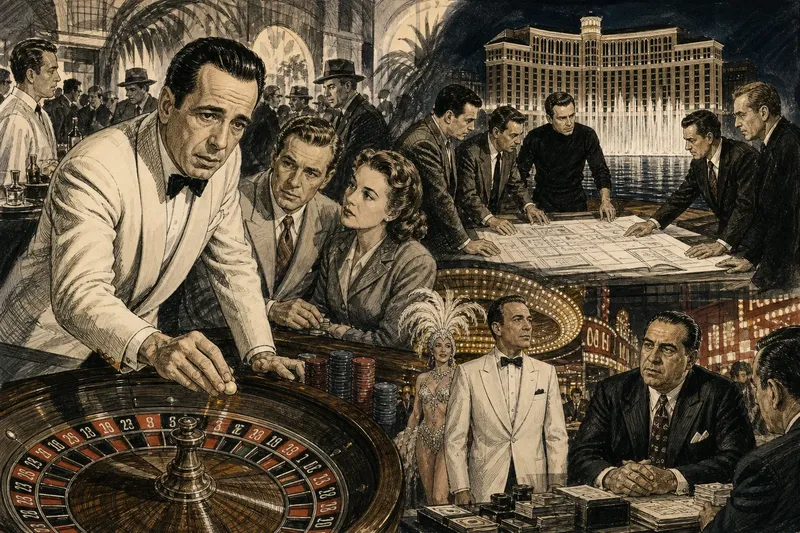
The casino in film first mattered as a place where a character could act, not merely as a display of lights and money. In Casablanca (1942), Rick’s roulette table gives him a way to help a couple leave the city. Later films turn casino venues into targets, businesses and stages for performance.
How does the casino in film move the story?
Rick’s Café Américain is a crowded social space, not a separate gambling hall. Its roulette table brings money, status and wartime uncertainty together. Rick uses it to secure the funds Jan and Annina Brandel need to leave Casablanca.
The game functions as a plot mechanism: Rick acts, and his action changes the Brandels’ prospects. The scene does not ask viewers to master roulette. It makes the table a point of decision, as immediate as a door that opens only when someone chooses to turn the handle.
This use of the casino differs from a location included chiefly for its recognised appearance. Here, the table’s role is inseparable from a particular relationship and a particular choice. The room provides the means for the scene to happen.
Why do heist films depend on a casino’s organisation?
In Ocean’s Eleven (1960), Las Vegas casinos are the targets of a planned robbery. Their routines, security and public show give the heist its structure. Visitors enter visible rooms, while access to other parts of the venue is restricted; the contrast shapes the crew’s problem.
The 2001 remake centres its plan on the Bellagio. The named venue is not simply a backdrop: the robbery depends on the casino as an organised business with spaces and procedures to overcome. The films turn attention towards planning, access and coordination, making the institution itself part of the action.
That emphasis gives the casino a different historical function from Rick’s roulette table. In Casablanca, a table allows one character to help another. In the Ocean’s Eleven films, the venue’s organisation creates obstacles and defines the scheme.
How did casino films use spectacle and business?
Diamonds Are Forever (1971) draws on Las Vegas casino display to suggest wealth, performance and possible deception. The setting establishes Bond’s surroundings, while the story supplies his particular reasons for being there.
Martin Scorsese’s Casino (1995) shifts emphasis towards the work and power behind public display. The rooms belong to a business whose operation matters to the story. Rather than treating the casino only as a recognisable sign of glamour, the film gives its enterprise a substantial place in the drama.
These films show two available uses of the venue, not a tidy succession in which one replaces the other. A casino can offer spectacle and still have a plot-specific function; it can also invite attention to the business that sustains the public rooms.
What changed as casino films accumulated familiar images?
Across these films, casino settings serve distinct purposes: assistance in Casablanca, a target in Ocean’s Eleven, a setting of display in Diamonds Are Forever, and a business in Casino. That range is more revealing than treating the casino as a single recurring symbol.
The useful historical question is not simply whether a film shows a roulette wheel or a formally dressed player. Ask what the scene’s place, people and arrangements allow the story to do. A familiar room may still be specific if its rules constrain a character or its resources make a decision possible.
Say you are comparing two invented scenes: in one, a character uses a casino table to settle a debt that changes an alliance; in the other, the same table appears while characters exchange information they could discuss anywhere. In the first, the game and its immediate consequence make the venue part of the plot. In the second, unless the casino’s rules or staff alter what happens, the location mainly establishes atmosphere.
What questions help explain the casino in film?
What does the roulette table do in Casablanca?
It gives Rick a means to help the Brandels leave Casablanca. The table matters because his decision has a direct consequence for them, rather than because roulette alone supplies visual interest.
Why is the casino central to Ocean’s Eleven?
The 1960 film makes Las Vegas casinos the targets of a heist, while the 2001 remake centres its plan on the Bellagio. In both, the venue’s organisation shapes the characters’ task.
How do Diamonds Are Forever and Casino differ?
Diamonds Are Forever draws on the spectacle of Las Vegas as part of Bond’s world. Casino gives more attention to the enterprise and power behind the public rooms.
Did familiar casino imagery displace plot-specific venues?
No. A recognisable casino could establish a setting quickly, while a particular venue could still organise action and constrain characters. These functions can coexist in one film.
Which details help distinguish a venue from a backdrop?
- Check whether a character has a specific reason to be there; if that reason drives a choice, treat the venue as part of the plot, but if no reason emerges, consider whether it mainly establishes atmosphere.
- Check whether a game’s outcome changes a decision or relationship; if it does, read the game as story action, but if nothing follows, treat it as visual texture.
- Check whether the film names a venue, such as the Bellagio in Ocean’s Eleven (2001); if its particular organisation shapes events, treat the place as specific, but if not, consider it interchangeable.
- Check what characters discuss at the tables; if they negotiate, threaten or decide something, the room supports that exchange, but if the conversation could happen anywhere, read the casino chiefly as atmosphere.
- Check whether staff, security or venue rules constrain the characters; if they do, the institution affects the action, but if they do not, treat the setting as a visual cue unless another detail gives it a function.
- Check what changes when the scene ends; if a decision, alliance or immediate prospect shifts, the location has helped produce a consequence, but if nothing changes, its main purpose may be to suggest glamour, risk or secrecy.
The history of the casino in film is therefore not a simple passage from useful setting to familiar image. Casablanca makes a table a means of assistance; Ocean’s Eleven makes the venue’s organisation the challenge; Diamonds Are Forever uses its public display; and Casino attends to the business beneath that display. The distinction helps explain why a casino scene can feel consequential even when its setting is already familiar: what matters is what the place lets its characters do.