How Casino Films Turn Venues into Story Settings
Learn how casino films turn venues into story settings, so you can distinguish dramatic atmosphere from practical details about how a real place works.
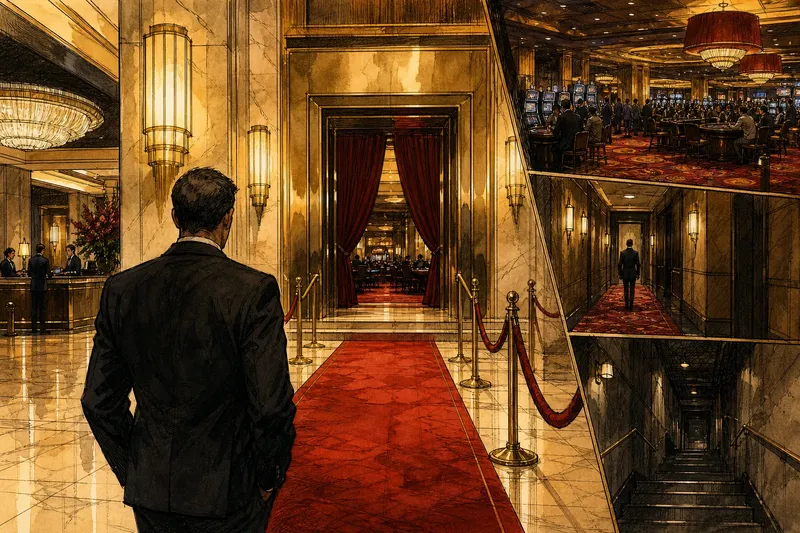
Casino films turn venues into story settings by making architecture serve character and mood. A casino scene may hinge on a particular threshold, carpet pattern or stretch of light; those details tell us how the film wants the place to feel, not necessarily how a real venue is arranged.
That distinction offers a more useful way to discuss casino culture on screen. Rather than treating a fictional room as a record of venue design, look at how its materials and boundaries shape the story’s sense of welcome, pressure or display.
What does the décor tell you about the story?
Notice which surfaces the film brings forward. Polished stone, dark timber, brass trim and patterned carpet carry different associations, even when the film never names them. A glossy lobby may suggest ceremony; a plain service corridor can make a character seem to have crossed into a less public part of the story.
These are artistic associations, not dependable descriptions of casino interiors. Production designers choose materials for colour, texture, lighting and narrative purpose. A close view of a velvet rope can make access feel restricted without establishing the venue’s actual entry policy.
It helps to separate what appears on screen from what it suggests. “The lobby is lined with dark timber” describes a visible feature. “The lobby makes the guest feel watched” describes an impression that can be supported by the camera’s placement, lighting and the character’s behaviour.
How do thresholds and routes shape the scene?
Doors, lifts, staircases and corridors give a scene a sense of movement. A character who passes from a bright public room into a narrow passage may seem to be leaving the spectacle behind. The route matters because the film has chosen to show that transition, not because it maps every connection in the venue.
Repeated spaces can also give a setting a distinctive rhythm. A film might return to the same doorway or corridor whenever a character is under pressure. The repeated location then works like a familiar object on a desk: its presence helps the viewer recognise a change in mood, even if nothing about the object itself has changed.
When describing movement, name the visible sequence: a character crosses the lobby, pauses at a doorway, then enters a room. Avoid claiming that the route is typical of real casinos unless the film itself supplies that information and your discussion is clearly about its fictional world.
How can you describe a venue without treating fiction as evidence?
Keep three kinds of statement distinct: a visible feature, a production choice and an interpretation. “A gold-coloured wall fills the background” is observation. “The lighting makes it appear warm” describes presentation. “The room feels opulent” is an interpretation, best supported by specific details rather than presented as a fact about the venue.
Imagine an invented scene in which a character enters a casino lobby with pale stone floors, brass-coloured rails and a red carpet leading towards a doorway. First, record those visible materials without calling the room luxurious. Next, note that the camera follows the carpet rather than showing the wider floor. Then describe the effect: the composition gives the doorway importance and makes the character’s approach feel ceremonial. The result is an account of the film’s design, not a claim about how actual casino lobbies are laid out.
When a film gives a specific name to a room or a material, you can report that as part of its fictional setting. When it leaves the detail unclear, use neutral language: “a carpeted passage” is more defensible than “the route to the high-limit room”.
What should you check before making a claim about a casino setting?
- Check whether the material is clearly visible; if it is, name it cautiously, and if it is unclear, describe its colour or texture instead.
- Check whether the camera shows the route between two rooms; if it does, describe that sequence, and if it cuts between locations, avoid claiming a continuous route.
- Check whether dialogue identifies a room’s purpose; if it does, attribute the label to the film, and if it does not, use a neutral description.
- Check whether a feature is part of the set or a character’s prop; if the distinction is visible, say which, and if it is not, describe only what appears in the frame.
- Check whether your wording states an observation or an interpretation; if it states an interpretation, support it with a visible detail, and if you cannot, soften or remove the claim.
- Check whether you are describing one fictional venue or casinos generally; if it is one venue, keep the claim within the film, and if you mean real places, seek a source about those places rather than relying on the scene.
What questions help when a casino setting is ambiguous?
Can a film’s lobby show how a real casino is designed?
It can show the production’s version of a lobby, with choices made for the story and image. Treat its layout and materials as features of the fictional venue unless you have separate, reliable information about a real place.
What if I cannot identify a material?
Describe what is visible, such as a reflective surface or a dark, grainy wall. Avoid naming stone, wood or metal unless the image makes that identification clear.
How should I describe an implied room?
Use the character’s action and the film’s wording: someone passes through a doorway, or a character calls a space a private room. Do not assign a specific function based on atmosphere alone.
Can décor support an interpretation of status?
Yes, as an interpretation, if you point to details such as formal furnishings, controlled access or the way other characters respond. Keep the claim about the scene’s effect rather than treating décor as proof of a real venue’s status system.
Why do fictional venues feel more complete than they are?
Films can connect separate rooms through editing, sound and repeated design details. A corridor shown in one scene and a grand room shown later may feel like parts of a coherent venue, even when the film has not established how they connect. That sense of continuity belongs to the storytelling.
For anyone writing about casino films, how casino films turn venues into story settings is a useful focus: describe the material and route the film actually presents, then explain the impression those choices create. Keeping that boundary clear makes room for interpretation without confusing a designed setting with a reliable account of a real casino.
When a scene leaves a doorway or room unexplained, that gap may be doing narrative work. It is often more revealing to note what the setting withholds than to fill in a floor plan the film never provides.