Casino, Resort, Venue: What Each Label Actually Says
Casino, resort and venue describe different parts of a place; learn what each label tells you, what it leaves open and what to verify before visiting.
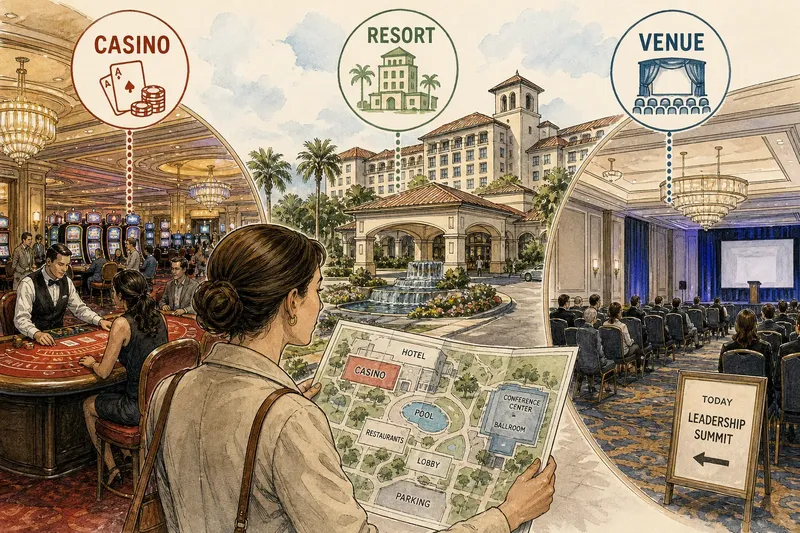
Casino, resort and venue are not interchangeable labels: each points to a different part of a place, and none tells you the whole story. A casino may be one operation inside a resort; a venue may be a room, building or broader destination. Read the word as a clue, then check what it actually refers to.
That distinction matters on a sign, a booking page or a map. The label may describe the main attraction, the accommodation, the operator or simply the space being discussed. Treat it like a name on a drawer: useful for locating one kind of thing, but not a complete inventory of what is inside.
What does “casino” identify?
“Casino” most directly identifies a place or business associated with gambling games. In everyday usage, it can refer to a dedicated gambling premises, the gaming floor within a larger property, or the company operating that area. The surrounding context usually tells you which sense is intended.
On a sign above an entrance, the word may name the destination. On a resort map, “casino” may mark one amenity among several. In a news report, it might refer to the operator rather than the building. The same term shifts scale, so ask what noun it is attached to: a room, a property, a business or an event.
The label does not, by itself, tell you which games are available, who may enter, what hours apply or whether the premises include dining and accommodation. Nor does it say that gambling is the only activity on site. Those details need their own descriptions.
What does “resort” add?
“Resort” usually presents a property as a destination with several guest-facing features. Depending on the place, those may include rooms, restaurants, pools, entertainment, meeting facilities or a casino. The word gives a sense of scope, not a promise that every familiar resort feature is present.
It also changes how a reader imagines distance. A casino described as part of a resort may sit within the same complex as a hotel, yet the walk between the entrance, guest rooms and gaming area can still matter. A property map is more useful than the umbrella label if you need to understand where facilities sit in relation to one another.
Look for the actual list of amenities and note which are on the property, which are operated by partners, and which may require separate booking or access. “Resort” tells you that the offer is broader than a single room or attraction; it does not settle what is included.
Why is “venue” the broadest label?
“Venue” names a place where an activity happens. It is deliberately flexible: a venue might be a casino floor, a ballroom, a theatre, a conference centre or an entire complex. The word says more about a place’s role in a particular sentence than about its full business model.
That flexibility makes “venue” useful in event listings and practical directions. “The venue” may mean the room where a performance takes place, even when the building also contains restaurants and gaming spaces. In a description of a casino, it may simply avoid choosing between the property, the operator and the gaming area.
When the term appears without a specific name, look for a nearby detail that pins down its scale: a room number, street address, event title or property name. If none is given, the label alone may leave the location ambiguous.
How can one property carry all three labels?
Labels often describe different layers rather than competing categories. A resort may own or host a casino, while a particular ballroom within it is the venue for a gathering. One property can therefore be a resort in a travel description, a casino in a gaming listing and a venue in an event notice.
Imagine you are reading a notice for a meeting at a hotel complex. It says the meeting venue is at a resort with a casino. You can infer that the event has a designated location inside a broader destination, and that gambling is associated with the property. You cannot infer that the meeting is in the casino, that guests receive access to every facility or that the resort includes any particular amenity. The room name or property map would resolve the first uncertainty; the event and property details would address the others.
For clearer reading, keep three questions separate: what is the place called, what kind of operation is being described, and where does the activity happen? A single label may answer only one.
What should you check before relying on a label?
- Identify the scale. Is the word naming a room, a building, a business or a destination? Look for a map, address or property name.
- Separate the operator from the place. A casino business can operate within a hotel or resort that has a different owner or management structure.
- Read the amenity list. Confirm which features are actually offered rather than assuming that “resort” supplies a standard package.
- Check the event location. A venue listing may name the complex but not the room or entrance used for the event.
- Notice what the wording leaves open. Access, opening times, services and eligibility are separate details, not consequences of the label.
These checks are especially useful when a short description compresses several layers into one sentence. A listing can be accurate and still too broad to answer a practical question. Find the more specific source attached to the detail you need, such as the venue’s event information for a room location or the property’s own amenities page for facilities.
Which label should a description use?
Choose “casino” when the gambling operation or gaming area is the point. Use “resort” when the wider destination and its guest facilities are relevant. Choose “venue” when the main concern is where a particular event or activity takes place.
In many sentences, the best description uses two labels with distinct jobs: “the casino at the resort” identifies the operation and its setting; “the venue is the resort’s conference room” identifies the event space. Adding a precise property or room name can remove the remaining doubt.
These terms are useful precisely because they are not synonyms. Casino, resort and venue tell you what kind of information a description is foregrounding. Once you know that, read the surrounding details for what the label cannot establish: the exact space, the available facilities and the arrangements that apply to your visit.